
Chapter 1
Chapter 1: The Boring Afternoon
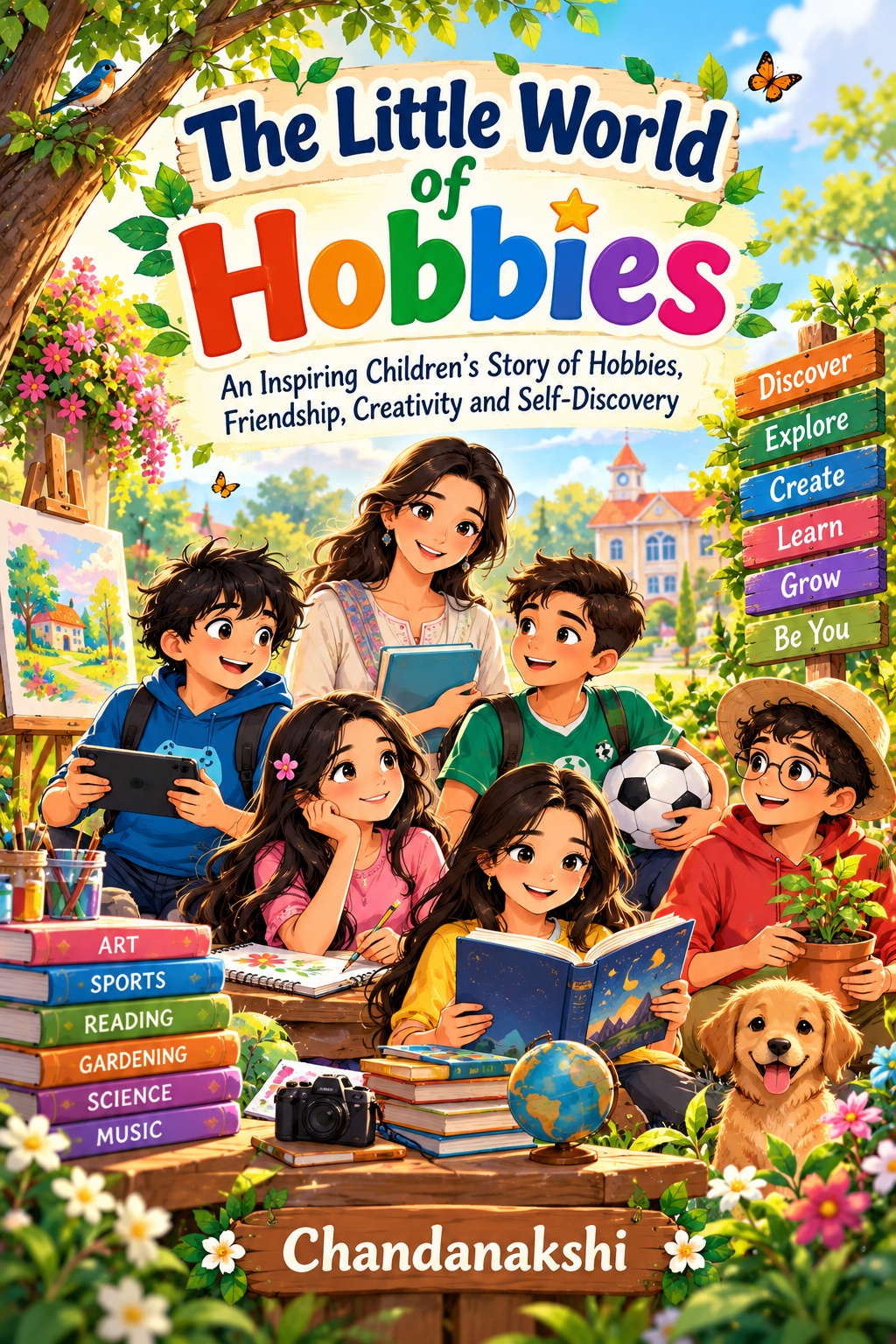
Discovering hobbies can turn an ordinary afternoon into an exciting adventure for children.
The afternoon sun shone brightly over the little town of Anandapur. Birds chirped from the branches of mango trees, butterflies danced around colourful flowers, and a gentle breeze moved through the open windows of houses.
It was a beautiful day.
But inside one particular house, twelve-year-old Aarav was experiencing the most boring afternoon of his life.
He was lying on the sofa, holding his mobile phone close to his face. His fingers moved quickly across the screen as he played his favourite game.
“One more level!” he murmured.
His mother walked into the living room carrying a basket of freshly washed clothes.
“Aarav, haven’t you been playing that game for the last two hours?”
“Just five more minutes, Mom.”
“You said that half an hour ago.”
Aarav didn’t respond.
His mother placed the clothes on a chair.
“Why don’t you go outside and play? The weather is lovely.”
“There’s nobody to play with.”
“Then read a book. You have so many books on your shelf.”
“I don’t feel like reading.”
“How about drawing something?”
Aarav sighed.
“Mom, I’m not interested in anything!”
His mother looked at him with concern.
“You cannot spend your entire afternoon looking at a screen. There are so many wonderful things you can do.”
“But everything is boring!” Aarav complained.
His mother smiled gently.
“Perhaps you haven’t discovered what you enjoy doing yet.”
Aarav returned his attention to the mobile phone.
He didn’t understand what she meant.
To him, an interesting afternoon meant playing games, watching videos or chatting with friends. He had never seriously considered doing anything else.
Five Children and Five Different Afternoons
A few streets away, another child was having a similar afternoon.
Meera, an eleven-year-old girl, sat at her study table. A beautiful drawing book lay open in front of her.
She picked up a pencil and began sketching a little house surrounded by flowers.
She had a wonderful imagination. Whenever she looked at something, she could imagine how to turn it into a picture.
But Meera had a problem.
She was afraid that people might laugh at her drawings.
Her elder brother once told her that her pictures looked childish. Although he had said it jokingly, Meera had taken his words seriously.
She closed her drawing book.
“What’s the point of drawing if I’m not good at it?” she whispered.
She placed the book inside a drawer.
Across the road, Kabir was lying on his bed.
Kabir loved cricket. He dreamed of becoming a great sportsman one day. However, he rarely practised unless his friends invited him to play.
He wanted to become successful, but he didn’t understand that success required regular effort.
“Tomorrow, I’ll definitely practise,” he told himself.
He had been saying the same thing for several weeks.
Meanwhile, Diya was sitting near her bedroom window, scrolling through short videos on her mother’s tablet.
There was a bookshelf in her room filled with wonderful storybooks. She had received many of them as birthday presents, but most remained unopened.
She enjoyed listening to stories, but she had never developed the habit of reading regularly.
And then there was Rohan.
Rohan lived with his grandparents in a house surrounded by plants.
His grandfather had a small garden with roses, jasmine, tulsi, tomatoes and several other plants.
Sometimes Rohan accompanied his grandfather to water them. He enjoyed watching butterflies and birds, but he never realised that these little activities could become something meaningful.
Five children.
Five different personalities.
Five different interests.
Yet they shared one common problem.
None of them knew how to use their free time meaningfully.
Monday Morning at School
The following Monday, the children arrived at Sunrise Public School.
Their classroom was filled with the usual noise of students talking, laughing and exchanging stories.
Mrs. Ananya, their class teacher, entered the room carrying a colourful box.
She was a kind and enthusiastic teacher who believed that education was not limited to textbooks, examinations and marks.
She placed the box on her table.
“Good morning, children!”
“Good morning, ma’am!” everyone replied.
“Today, I want to ask you something different.”
The children looked at her curiously.
“What do you usually do after school?”
“Play cricket!” shouted Kabir.
“Watch television,” said another student.
“Play mobile games!” Aarav answered proudly.
“Sleep!” someone shouted from the back.
The entire classroom burst into laughter.
Mrs. Ananya smiled.
“Those are some interesting answers. But let me ask you another question. What do you do when you have absolutely nothing to study and no homework to complete?”
“Nothing, ma’am,” Aarav replied.
“Nothing?”
“Yes, ma’am. I just play games or watch videos.”
Mrs. Ananya nodded.
“Does anyone spend time learning something new?”
Silence.
“Does anyone paint, read, write stories, play a musical instrument, grow plants, collect interesting objects, build things or explore nature?”
A few children exchanged glances.
Meera slowly raised her hand.
“I sometimes draw pictures, ma’am.”
“That’s wonderful, Meera! Do you enjoy drawing?”
Meera hesitated.
“Yes, ma’am. But I’m not very good at it.”
Mrs. Ananya smiled.
“Nobody becomes good at something without learning and practising.”
She turned towards the class.
“Children, today I want to introduce you to a beautiful word.”
She wrote a word in large letters on the blackboard.
HOBBY
An activity we enjoy doing in our free time.
“What is a hobby?” she asked.
Nobody answered immediately.
“A hobby is something we choose to do because we enjoy it. It can be painting, reading, gardening, singing, dancing, cooking, playing sports, photography, writing, solving puzzles or learning about science.”
She opened the colourful box.
Inside were several objects: a paintbrush, a small football, a storybook, a musical instrument, a packet of seeds, a magnifying glass and a miniature robot.
The children’s eyes widened.
“These are not just objects,” she explained. “Each one represents an opportunity to discover something new.”
Aarav looked at the miniature robot.
“Ma’am, can we really make robots ourselves?”
“Of course! With curiosity, learning and practice, you can begin building simple robots.”
Meera picked up the paintbrush.
“Can we learn painting even if we don’t know how to draw properly?”
“Absolutely!”
Kabir looked at the football.
“Can playing football or cricket become a hobby?”
“Certainly. Sports are wonderful hobbies. They help develop physical fitness, teamwork, discipline and determination.”
Diya picked up the storybook.
“Can reading stories be a hobby?”
Mrs. Ananya laughed.
“One of the loveliest hobbies!”
Rohan examined the packet of seeds.
“And gardening?”
“Yes, Rohan. Gardening teaches us patience, responsibility and respect for nature.”
The children began looking at the objects with excitement.
For the first time, they realised that there were so many activities they could explore.
An Unusual Challenge
Mrs. Ananya waited until everyone settled down.
“I have a challenge for all of you.”
The classroom became silent.
“For the next thirty days, I want each of you to discover one activity that genuinely interests you. Choose something you would enjoy learning, even if you are not good at it initially.”
She wrote three instructions on the blackboard.
- Discover something you enjoy.
- Spend a little time practising it regularly.
- Observe how you improve.
“At the end of thirty days, we will organise a Hobby Discovery Day. Every student will get an opportunity to share what they have learned.”
“Will there be prizes, ma’am?” Kabir asked.
“There may be certificates and special recognition. But remember something important: the biggest prize is what you learn about yourself.”
The children smiled.
Aarav raised his hand.
“Ma’am, what if we don’t have any talent?”
Mrs. Ananya looked at him kindly.
“Who told you that you don’t have talent?”
“I don’t know. I have never tried anything special.”
“Then how can you decide that you have no talent? Imagine a seed buried in the soil. Can anyone tell what kind of plant it will become without allowing it to grow?”
“No, ma’am,” the children replied.
“Exactly! Every child has the ability to learn, explore and develop. But abilities need opportunities, patience and practice.”
She paused before adding:
“Never compare your beginning with somebody else’s achievement.”
Those words remained in Meera’s mind.
The First Step
That evening, the five children walked home together.
“Are you going to participate?” Diya asked.
“Definitely!” Kabir replied. “I’m going to become the best cricket player in our class.”
“Don’t think about becoming the best immediately,” Meera said. “First, learn to practise regularly.”
Kabir laughed.
“Look who’s giving advice! You hide your drawings from everyone.”
Meera looked down.
Diya gently held her hand.
“You should draw something for the exhibition. I would love to see it.”
Aarav was unusually quiet.
“What about you, Aarav?” Rohan asked.
“I don’t know yet. But that little robot in the classroom was interesting.”
“Maybe you can learn how to build one,” Rohan suggested.
“Perhaps.”
They reached the crossroads where they usually separated.
Before leaving, Diya said something that made everyone think.
“What if we all discover something we really love doing?”
“Then we’ll have something interesting to talk about every day!” Rohan answered.
They laughed and went home.
That evening, something different happened in each of their houses.
Meera opened her drawing book again.
Kabir took his cricket bat and went outside to practise.
Diya walked towards her bookshelf and selected a storybook.
Rohan asked his grandfather to teach him how to plant seeds.
And Aarav?
He switched off his mobile game and searched for beginner robotics projects.
It was only the beginning.
None of them knew what the next thirty days would bring.
But one thing had changed.
They were no longer waiting for something interesting to happen.
They had decided to make something interesting happen themselves.
Discovering Hobbies: What Children Will Learn
1. Free time is valuable. We can use it to explore, learn and enjoy meaningful activities.
2. Everyone has different interests. Not every child needs to enjoy the same activities.
3. Talent develops through practice. We should not give up simply because we are beginners.
4. Don’t compare yourself with others. Everyone has a different learning journey.
5. Trying something new is the first step. We cannot discover our interests without exploring different activities.
Think About It
- What do you usually do during your free time?
- Have you ever wanted to learn something but hesitated to try?
- What are three activities you would like to explore?
- Why shouldn’t we compare our talents with others?
Your Little Challenge
Discover Yourself!
This week, try one activity you have never seriously explored before.
- Drawing or painting
- Reading a storybook
- Gardening
- Singing or dancing
- Playing a sport
- Writing a story or poem
- Building or creating something
My first hobby to explore: __________________
My goal: I will spend 15–20 minutes practising it.